The area of aromatic plants in our Organic garden represents an area of aggregation of pollinating insects which are typical of this environment.
Most of the aromatic plants belong to the family of the Lamiaceae (Labiate), which have a type of “entomogama” pollination which basically relies only on insects.
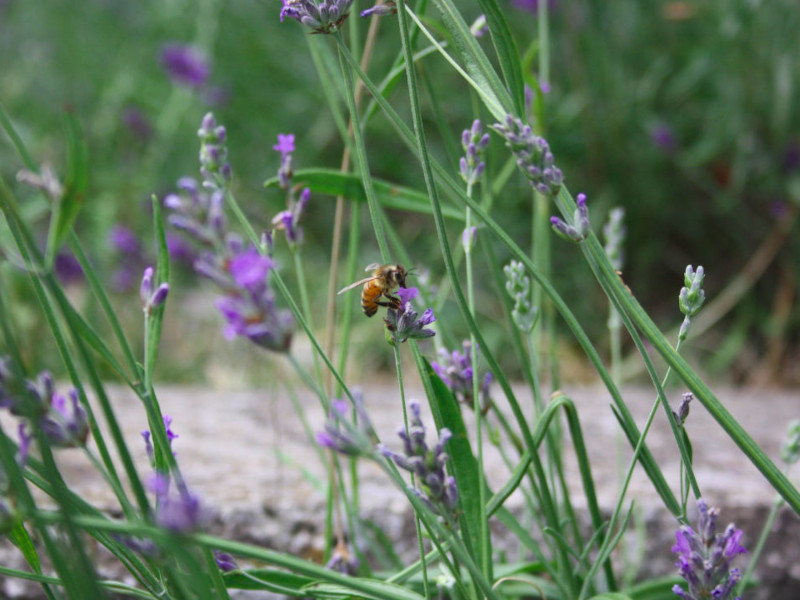
Pollinating insects are those insects that transport pollen from one flower to another allowing pollination and the subsequent formation of the fruit. Many are the insects that are capable of performing this task, among which the most important are definitely bees.
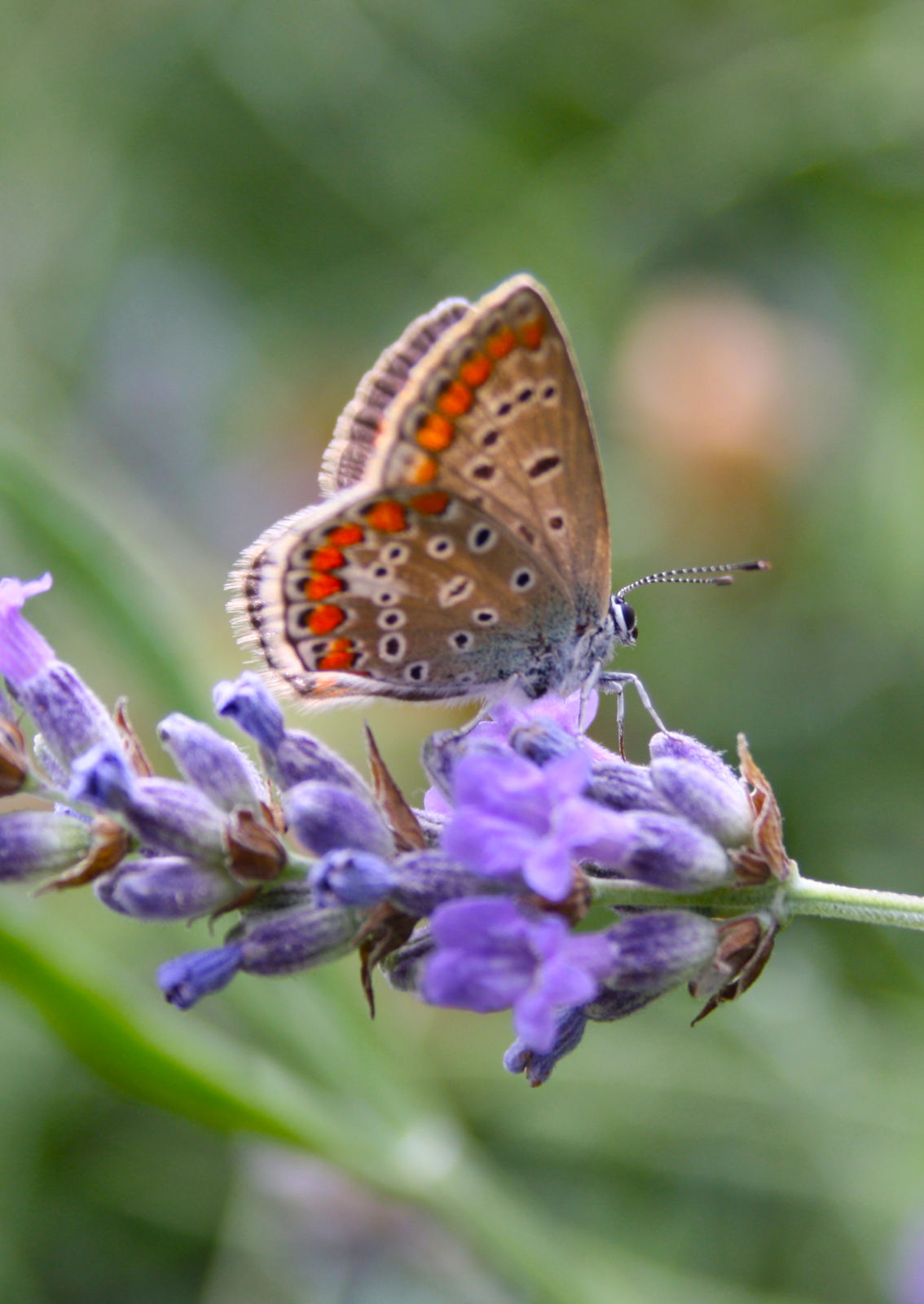
Pollinating insects have morphological characteristics which are suitable for their “specialization”: the body is covered by very dense bristles which is ideal for making the pollen stick and transporting it from flower to flower. The mouthparts are sucking or lambent-sucking and serve to collect the sugary liquids like the nectar of flowers.
Some insects have more marked “specializations”. In the Apoideans, (superfamily of hymenoptera collecting pollen like bees) for example, the tibiae of the hind legs are dilated and have an external concavity. Here the pollen collected and retained in a globular mass by bristles, and then arranged along the edge of the external cavity, accumulates. Another organ that Apoidei insects have is the ”spazzola”, which means “brush”, a formation of robust bristles on the hind tarsus, which the insect uses to “brush” the body and collect pollen.
Pollinating Insects include the following “Taxa” (Orders):
Pollinating Insects And Flowers… These Two Are Linked By Destiny
If the flowers disappeared, the insects would die too.
If the bugs disappeared, the flowers would die.
Ad essere maggiormente colpite sono le specie più specializzate che si nutrono del nettare e del polline di un unico tipo di fiore.
Negli ultimi decenni stiamo assistendo al fenomeno di diminuzione degli insetti, di conseguenza, stanno diminuendo anche molte piante che si affidano agli insetti impollinatori, il loro posto è stato preso da piante che sono impollinate attraverso il vento e l’acqua.
The most affected are the more specialized species that feed on the nectar and pollen of a single type of flower.
In recent decades we have been witnessing the phenomenon of insect decline and that is because of the number of plants on which pollinating insects rely on is also decreasing. Their place was taken by plants that are pollinated through wind and water.
The disappearance of insects is not only a problem for ecologists. Not only the lack of conditions for the reproduction of wild plants leads to serious consequences for biodiversity, but also the phenomenon generates considerable economic repercussions. Many crops, in particular vegetables and fruit trees, rely on bees, bumblebees and butterflies for pollination. In recent years there has been a need to operate an artificial pollination (manual or mechanical) in different crops (cucurbits, tomato, olive, kiwi, etc.) with subsequent additional costs.
To encourage the spread of insects, some measures such as leaving spontaneous vegetation near the crops must be applied in agriculture.
Pollinating insects play a crucial role in fruit and horticulture. Thanks to their activity we produce apples, pears, peaches, cherries, plums, apricots, almonds, strawberries, etc.
Pollinating insects can be used, in the biological fight, for the transport of microorganisms (fungus, bacteria and viruses) useful to fight some of the adversities of the cultivated plants.
Moreover, the relationship between pollinating insects and plants is used in environmental monitoring as a biological indicator.
Gli insetti impollinatori rivestono un ruolo cruciale in frutticoltura e orticoltura: grazie alla loro attività abbiamo produzioni di mele, pere, pesche, ciliegie, susine, albicocche, mandorle, fragole, ecc. Gli insetti pronubi possono essere utilizzati, nella lotta biologica, per il trasporto di microrganismi (funghi, batteri e virus) utili a combattere alcune tra le avversità delle piante coltivate. La relazione tra fra insetti impollinatori e piante è utilizzato nel monitoraggio ambientale come indicatore biologico.
How flowers attract insects?
The relationship between pollinating insects and plants can reach surprising levels of specialization.
Plants have developed many curious and often incredible methods to attract pollinators: visual cues, odorous baits, reward in food, mimicry and also trapping.
Plants that rely on visual signals generally have petals with bold colours and colourful patterns. Some flowers have small patterns of various shapes, dots, lines to guide certain pollinators to nectar and pollen.
There are many species-specific relationships, for example: bumblebees are the main pollinators “chosen” by the Snapdragons. Their flowers are solid, irregular in shape, with landing platform. Only insects like bumblebees are the right size and weight to be able to open them and reach pollen and nectar. Other species of bees or other insects that are too small or too large are excluded.
Similar specificity exists between many species of orchids and their pollinating insects, but there are also orchids which are not nectariferous that imitate the shape of the females of the pollinating insects; these try, but failing, coupling and thus they load up themselves with pollen.
Consulenza dott.ssa Iris Biondi