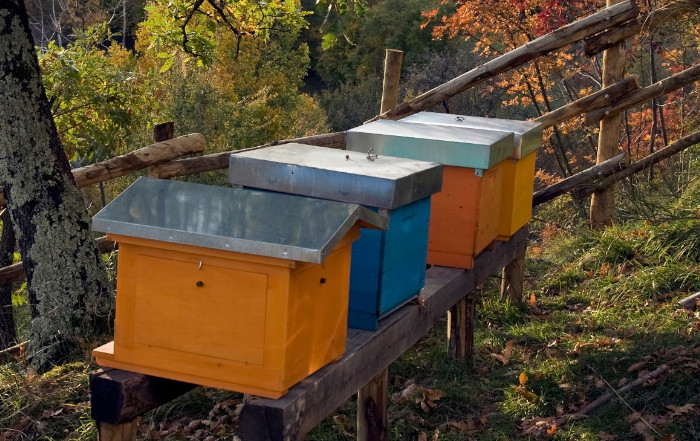
The bee is a social insect that lives in a colony called hive. The beekeeper offers the bees a house called hive, in change of their honey. Bees play a fundamental role not only in the production of honey, royal jelly, propolis and wax, but also in terms of pollination. Beekeeping is defined by Italian law as an activity of national interest for the conservation of the natural environment, the ecosystem and agriculture in general. Inside the hive, life takes place on the honeycombs which are built entirely by bees with a substance that they secrete called wax. They are arranged vertically, parallel to each other and there is just far enough space to allow two bees to pass through. The honeycomb is made up of hundreds of hexagonal cells that serve to hold the eggs and larvae, the brood, which is placed in the central part of the honeycomb and the honey and pollen is in the upper and lateral areas.
A family of bees consists of at least 10,000 bees during the winter rest period, and 30,000 to 60,000 during the active period. The queen bee is the only fertile female. She differs from the other bees by her longer and bulkier abdomen (total length 18-20 mm) and she can live up to 4 or 5 years. Her job is to lay eggs. When the good season starts it can lay up to two thousand eggs in a day. It lays a fertilised egg in the normal-sized cells that will give life to a female bee, and an unfertilised egg in the larger cells from which a male bee will be born. The egg hatches after three days and a small larva is born, which is fed for the first three days with royal jelly and then with pollen and honey. Royal jelly is secreted by the hypopharyngeal and mandibular glands of the nurse bees. 21 days after the egg is laid, the young bee breaks the operculum with its mandibles to finally emerge from the cell.
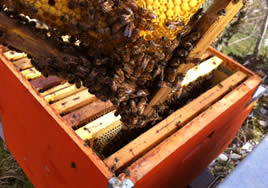
The drone is the male bee, has no sting and it’s about 15 mm long. Its job is to fertilise the queen, and it lives about one season. The worker, instead, is a sterile female and it is about 12-13 mm long. In the hive we can count a few tens of thousands of them, they live about 40 days in Summer and then they survive the Winter during the bad season. Its body is extremely versatile, that’s the reason why it performs all the work necessary for the family throughout its entire life, from feeding the young larvae and the queen, to cleaning the cells, transforming nectar into honey, building the combs, and collecting everything that is necessary for the bee life in the hive such as water, nectar, pollen and propolis.
Nectar is “sucked” with the ligule from the flowers’ calyx to be then stored in the “honeycomb sac” and transported to the hive. Pollen is collected by the bee on the stamens, the male part of the flowers, using the mandibles and then packed and transported on the bristles of the hind legs called “baskets”. Worker bees also collect the sugary secretions produced by certain insect species, known as honeydew, while they collect resin and propolis from buds and they use them to seal every crevice in the hive.