Berries
The undergrowth is a place rich in often unknown treasures, where the sun reaches the moss and ferns, and all the vegetation forms a thick mat from which small shrubs rise. Berries are small fruits that sometimes are forgotten or neglected, there are some such as: blueberry, raspberry, redcurrant, blackcurrant, blackberry, gooseberry, wild strawberry.
All these kinds of berries are at risk because the territory is left to itself and they risk to disappear, although the simplicity of their needs, the durability of the plant and the prospect of minimal pesticide interventions should stimulate cultivation, also aiming to diversify crops and thus provide a valid alternative to other kinds of fruits.
Blueberries and raspberries are naturally part of the flora of the entire mountainous and hilly area of Italy. The blackberry shrub, which is a wild shrub, often infests abandoned land and the margins of watercourses throughout the national territory. Only the different types of currants and gooseberries are rarer in the wild, but they are easy to find in gardens as ornamental shrubs due to their pleasant appearance.
Since they are species that generally require few pesticide treatments, or even none as in our case, they are therefore suitable for children, as they are a natural first-rate tonic for them. Recent laboratory studies have indeed highlighted how strawberries and small fruits contain very important substances from a nutritional point of view, namely polyphenolic compounds with antioxidant properties, which are present in very high percentages, especially in wild species.
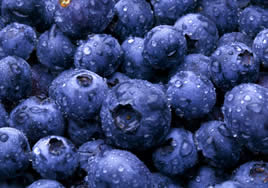
It is a small deciduous shrub which is native to Northern Europe and grows spontaneously in all temperate-cold areas of the northern hemisphere. It belongs to the Ericaceae family.
Due to their mountainous origin they require the presence of very fresh and organic soils with acidic pH (4-5). It has underground stems, small, oval or lanceolate leaves, bright green in colour that turn yellow-gold or reddish in Autumn. In late Spring, it produces small clusters of bell-shaped flowers, slightly waxy, white in colour. In early Summer or early Autumn, depending on the species, round fruits ripen and they are small berries covered with a layer of pruina that makes them opaque, blackish in colour (V.myrtillus), red (V. vitis idaea) or blue (V. uliginosum), or larger berries collected in clusters typical of the American giant blueberry (V. corymbosum).
Generally speaking, blueberries ripen nonstop over a period of 3-4 weeks. These fruits are highly appreciated to be eaten fresh or made as jams, syrups, flavoured spirits with a delicate flavour and intense aroma, and they are used both in herbal medicine and in the pharmaceutical industry, since they are also rich in vitamins and flavonoids.
The blueberry contains significant amounts of organic acids (citric, malic…), sugars, pectins, tannins, myrtillin (colouring glucoside), anthocyanins, vitamin A, C, and in smaller quantities vitamin B. In particular, the favourable properties of anthocyanins on retinal and general capillaries are emphasized. The fruit is also indicated as a urinary antiseptic and, especially when dried, it has astringent properties and can be used as an antidiarrheal, as recommended by Dioscoride (1st century AD) to treat diarrhoea.
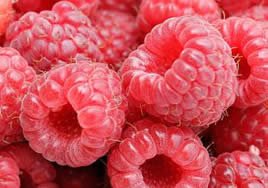
Together with the blackberry, it belongs to the Rosaceae family.
Raspberry varieties can be grown in any Italian climatic environment and require fresh, organic, and generally acidic soil. It is a species that bears fruit in stages in June, July and August. The plant is a 70-80 cm tall bush (but can also reach two meters in height) that develops a lot of sprouts at the base of the steam and from the roots every year. Their vigorous growth over time can make the plant invasive, but thus allows for an almost unlimited duration of cultivation.
The pinkish-white flowers, are clustered in sparse clusters and the fruit consists of numerous small red drupes with a sweet-sour flavour highly appreciated in food applications. Indeed, raspberries can be used to make jams, syrups, jellies and they are also used in the liquor industry.
Raspberry can be also used as a medicinal herb as a diuretic and cholagogue. An infusion of its leaves is useful against diarrhoea. The active ingredients contained in the plant are tannins, vitamin C, flavonoids, and organic acids.
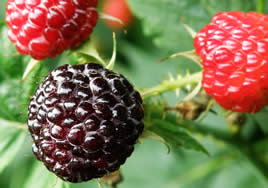
The blackberry bush is widespread in the most inaccessible places. The wild blackberry (Rubus) takes on a very different appearance depending on the species (there are more than 40) and generally it looks like a bush with very long stems and has a high pollen capacity.
Cultivated blackberry, which is obtained by a selection, has larger fruits and it is distinguished into creeping and thorny varieties and vertical-growing varieties without thorns.
The pinkish-white flowers, are clustered in terminal inflorescences, and like in raspberries, the fruit consists of numerous red or black drupelets that, however, do not detach from the receptacle when ripe and must be harvested with the stem.
Fruit production begins in mid-June and continues throughout the Summer. The intense and pleasant aroma and the shiny black colour make blackberries a precious ingredient for many preparations such as jams, as well as for fresh consumption. A decoction of blackberry leaves is an effective astringent and can also be used as a facial lotion or against mouth ailments.
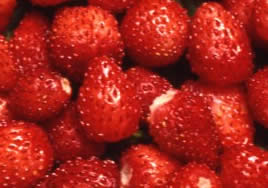
The wild strawberry is a shrub that comes from the Rosaceae family. It can be found in the wood and it is cultivated for its fragrant fruits which are small strawberries with both a delicate and intense aroma. The wild strawberry is distinguished from the cultivated hybrid varieties of Fragaria by the fact that the fruit is small and soft (hence the name “vesca”, which means “soft” in Latin).
According to some sources, the name “fragaria” derives from the Sanskrit “ghra” that means “fragrance”. In folk tradition, it is used to relieve gastrointestinal disorders. The active ingredients that are contained in the plant are essential oils, tannins, and flavonoids. It also contains good doses of vitamin C, iodine, iron, and calcium.
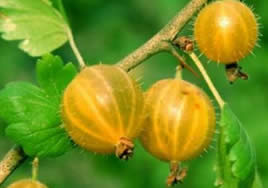
It belongs to the same family and genus as black and red currant and it has similar needs when growing. It forms more open bushes and the branches, as the name suggests, are covered with prickles.
The fruits are large berries and their colour varies from greenish-white, honey-yellow or red. The cultivation of gooseberries dates back to the 1700s in England, from where it soon spread to other European countries.
Gooseberries have diuretic and mild laxative properties and in folk tradition they are recommended for those suffering from rheumatic pain and gout, as well as for oral inflammations.
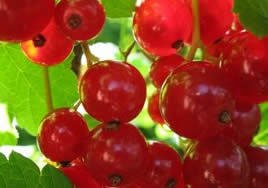
It belongs to the Grossulariaceae family and it is a perennial shrub made of bushes that in July are covered with clusters of black fruits (Ribes nigrum) or red fruits (Ribes rubrum) with a sweet-slightly sour, watery pulp containing a lot of tiny seeds.
The red currant has diuretic, refreshing, and mild laxative properties. The fruits are used fresh, in the form of juices, jellies, sorbets, liqueurs and as garnishes for sweet and savoury dishes.