The “herbes’ garden
Medicinal and aromatic herbs play a vital role in improving agricultural production, food availability and keeping alive the environmental biodiversity. Numerous historical sources attest that such herbs have been known since ancient times, particularly for their antiseptic properties and aromatic qualities for culinary use.
Lunigiana is rich in edible medicinal and wild plants and herbs, which are often used in the preparation of the tasty dishes of the local culinary tradition, such as the characteristic “torta d’erbi” (herbs pie).
In our Organic garden, it is possible to find a selection of many of the aromatic and medicinal herbs that we are used to know nowadays, most of which are native, such as borage, marjoram, dandelion, rosemary, wild thyme, wild sage, as well as lemon balm, chives, chamomile, wild fennel, hypericum perforatum (commonly known as St. John’s wort), and lavender. You will find information about some of them below.
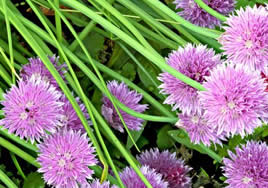
It is a plant that comes from Asia and belongs to the Liliaceae family, it has a great ability to regrow when subjected to continuous and constant leaf harvesting. It forms pleasant clusters of leaves among which numerous pink-purple flower heads emerge in the Summer season. It is often used as an ornamental species for borders and rock gardens. In cuisine, it is used to give flavour to salads and is preferred, by many, over onions for its more delicate aroma.
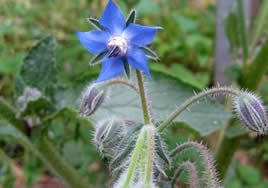
It is a plant that comes from the Mediterranean area where it still grows wild. It is grown in all temperate regions of the globe. The name comes from the Latin “borra” (rough woolen fabric) for the hairiness that covers the leaves. Others trace it back to the Arabic “abu araq” through medieval Latin “borrago”, perhaps due to the plant’s diaphoretic properties. The flowers, which have five blue-violet petals arranged in a star shape, are pendulous and short-lived. The young leaves are used in different ways in cooking: for making salads, soups, and as a filling for tortelloni (ravioli). In folk medicine, the leaves and blue-violet flowering tops are used to reduce fever and calm coughs.
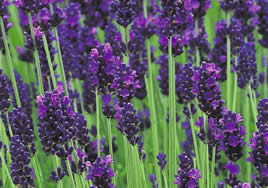
It is a plant that comes from Mediterranean regions, it is grown, particularly in arid and rocky areas, and has been known since ancient times for its antiseptic, analgesic, bactericidal, vasodilatory, antineuralgic properties, as well as for muscle pain relief and it is also considered a mild sedative. Apart from the hybrids and horticultural varieties, there are many other species of lavender. Lavender flowers that grow from June to September, unlike many other species, keep their aroma for a long time even when dried. Lavender essential oil is a highly appreciated fragrance. In antiquity, the plant was also used for the preparation of talismans and good luck charms, linked to magical and esoteric practices.
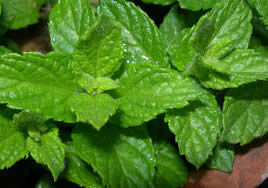
It is a plant that comes from Northern Europe, although believed to come from hybridization among different species. It adapts very well to different climates, preferring semi-shaded locations and cool, deep and well-fertilized soil. The genus Mentha includes about forty species that share similar characteristics and they are all used in cooking and herbal medicine. The essential oil present in all species is menthol, which is used for the preparation of syrups and in the cosmetics industry.
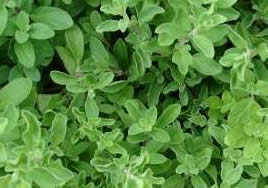
It is a plant already known by the ancient Greeks for its aromatic and medicinal properties. It prefers warm and temperate climates, with a creeping habit not exceeding 50 cm in height. The stems, which produce numerous branches, are hairy when they first grow, while the leaves are small and oval-shaped, with inflorescence formed by whitish panicles. The leaves and the flowering tops are harvested in the Summer season and the branches can be dried in the shade and stored in dark glass jars and used in Winter. Marjoram is indeed one of the main “flavours” of Mediterranean cuisine, used to give flavour to savoury pies, omelettes, grilled meat and fish and is also often used in infusions against insomnia.
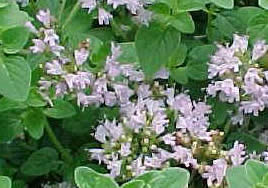
It is an oriental plant that grows spontaneously in Mediterranean regions. It prefers warm temperate climates and suffers from frost. It adapts to any type of soil, as long as it is well-drained and exposed to sunny positions. The plant reaches 60-70 cm in height and it has some stems with leaves only (which are smooth, small, and oval-shaped) and others with flowers (which can be white or pink). The widespread use of this species is linked to the pleasant aroma that characterises many dishes of Mediterranean cuisine, such as the classic Italian pizza. However, it is also used in food preservation and in the food industry.
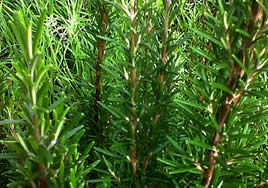
It is an evergreen shrub typical of the Mediterranean basin that can reach up to two meters in height and develop horizontally. Its leaves are leathery and needle-like, and its flowers have a blue corolla. The name “rosemary” seems to derive from the Latin “rhus marinus” meaning “dew of the sea”. In the Middle Ages, it was considered a plant of health, a panacea for all kinds of ailments. Today, its use is diminished, but in cooking, it is the primary seasoning for roasts and is used in the preparation of many different dishes.
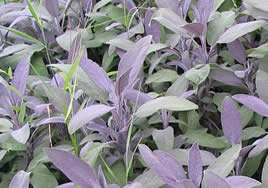
The sage is an evergreen shrub with a bushy appearance and semi-herbaceous branching, typical of the Mediterranean area. The leaves are long-stalked, very hairy, and with a lamina rich in thin veins, giving them a mosaic-like appearance. The purple inflorescence is terminal. The sage’s healing properties have been confirmed by modern science, which has recognized its stimulating, anti-inflammatory and antiseptic properties. In cooking, the leaves are used to give flavour to roasts and meats.
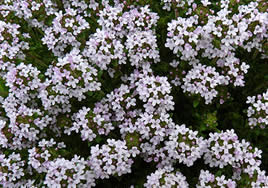
It is a shrub of small dimensions (not reaching 30 cm in height), typical of the Mediterranean basin, it also adapts very well to cold and mountainous environments in well-drained chalky soils. Due to the small size of its lanceolate leaves, it is often used in rock gardens and as a ground-covering plant. The harvesting of thyme can start from the time of flowering around May and continue throughout the Summer by cutting off the herbaceous branches, which can then be stored after drying in the shade. In ancient Greece, it was a plant sacred to Venus and Mars. The leaves and flowers contain an essential oil called thymol, which has remarkable bactericidal, antifungal, antiseptic and antiparasitic properties. In cooking, it is used as a flavouring, either alone or with other spices.