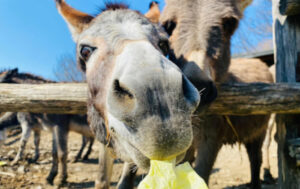
Human history has always been accompanied by the presence of animals. Meat animals such as goats and cattle have been the first to be bred around eleven thousand years ago. In later times, when man started moving around and engaging in trade the domestication of work and pack animals took place. One of this animal was the donkey of which the oldest fossil, dating back six thousand years, has been found in Egypt. It was most likely descended from the Equus asinus africanus. It then spread to Syria, Mesopotamia, Persia, Tibet and throughout Asia, as shown by the two related species the Onager and the Hermione, arriving in Europe during the Neolithic period.
Thanks to its endurance and innate docility, the donkey (Equus asinus domesticus), has always been used in agriculture, also because it has always been a cheaper animal to purchase than the horse and also better suited to endure the hard work in the fields and as a means of locomotion. Thanks to its adaptability to a wide variety of environmental conditions and the ease with which it was bred, it was very common on small farms and among many rural families.
It was used for pulling wagons, for saddling, for working in the fields, for driving millstones and for basting, as well as for transporting sacks of chestnuts and loads of various kinds even on steep and difficult terrains. Even in Apella every family had at least one donkey, which they jealously guarded, especially for the Autumn season when they had to use them for the chestnut harvest. They help themselves by using donkeys to transport the chestnuts to the chestnut dryers and mills that where always very far from the chestnut groves on the slopes of the Apennines. The absence of a donkey in a peasant family meant a serious lack as this saying recalls: “there is no such a stupid person than a farmer without a donkey”.
In recent times due to the progressive mechanisation of agriculture, the animal has lost its former use and it has been neglected if not even forgotten. Some breeds have now disappeared. However, in recent years the donkey has been at the centre of an economic and social rediscovery, regaining prestige thanks to new complementary uses connected to agriculture and tourism such as “donkey therapy”, as part of the more genreal “pet therapy”, but also for a sustainable tourism, such as walking and trekking, and animation. According to recent Coldiretti data, more than 5000 donkeys of eight different species (Amiatina, Asinara, Grigio Siciliano, Martina Franca, Pantelleria, Romagnola, Ragusana and Sarda) are bred in our country. The donkey is above all a very curious animal that approaches to check everything it sees, sometimes even pushing, sniffing and biting, sometimes even seeming a bit intrusive. It tends to be sociable, that’s why it does not like to be alone for too long. It prefers the company of other donkeys, but it also get well along other animals such as horses, sheep, dogs, geese and ducks. At times, the donkey may appear disobedient, but this is often just a matter of caution and fear. When faced with new situations, it needs calm and time to make sure it is not in danger.
In other occasions, disobedience is an attitude that the donkey expresses in order to be more considered or assisted. The braying, which is much more frequent in young donkeys, manifests its state of unease. Indeed, it indicates situations of discomfort or when it is suffering from loneliness.
In addition, it has good memory in relation to both humans and other animals and places, easily remembering cares, mistreatment and punishments. The donkey is a clean animal and this is manifested by its need to roll on the ground (something typical among equines). This is the only way it can get rid of parasites in its fur and skin. In captivity, the average life of a donkey is around 30-35 years but it can be up to 45 years.
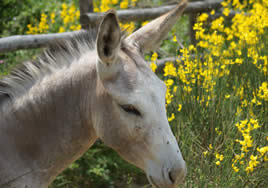
Amiata Donkey
The Amiata donkey has Tuscan origins and it is particularly widespread in the Amiata area (Grosseto) where it is also known by the name “sorcino crociato”. It can be bred for pack, light draught and service use. Its slender shape and particular resistance make it suitable for use in marginal areas. It has a grey coat with characteristic zebra stripes on the limbs, dark rimmed ears, light grey muzzle and belly, proportionate head, straight ears, muscular neck, strong straight shoulder, sloping croup, open chest and broad thorax. It also has mall and strong limbs, strong feet with compact hoof. The height at withers is around 130-140 cm in males and around 125-135 cm in females.
Something very characteristic is the St. Andrew’s cross formed by the line running from the neck to the tail and the line running down along the shoulders. In Christian popular and religious tradition, this characteristic has been linked to the life of Jesus, which is frequently marked by the presence of the donkey: a donkey warmed him in the cave, a donkey carried him when escaping and going to Egypt, a donkey carried him triumphant into Jerusalem. It is from this last episode that, as the Christian tradition suggests, the donkey carries the typical black cross on its back.